There are sandwiches, and then there are sandwiches that become inseparable from the identity of an entire city.
In İzmir, on Turkey’s Aegean coast, one sandwich occupies that special place: kumru. Warm, crusty, sesame-covered bread filled with grilled meats, melted cheese, tomatoes, and peppers, kumru is more than a quick meal. It is a piece of İzmir’s street-food culture—casual, generous, intensely flavorful, and deeply connected to the city’s everyday rhythm.
You can eat kumru after a day at the seaside, during a late-night walk through the city, as a quick lunch between errands, or simply because you happen to pass a shop where the smell of toasted bread and sizzling meat is impossible to ignore.
For visitors discovering İzmir for the first time, kumru can be an introduction to the city itself: warm, relaxed, local, and unmistakably Aegean.
What Exactly Is Kumru?
At its simplest, kumru is a Turkish grilled sandwich traditionally associated with İzmir.
But calling it simply a “sandwich” does not quite capture what makes it distinctive.
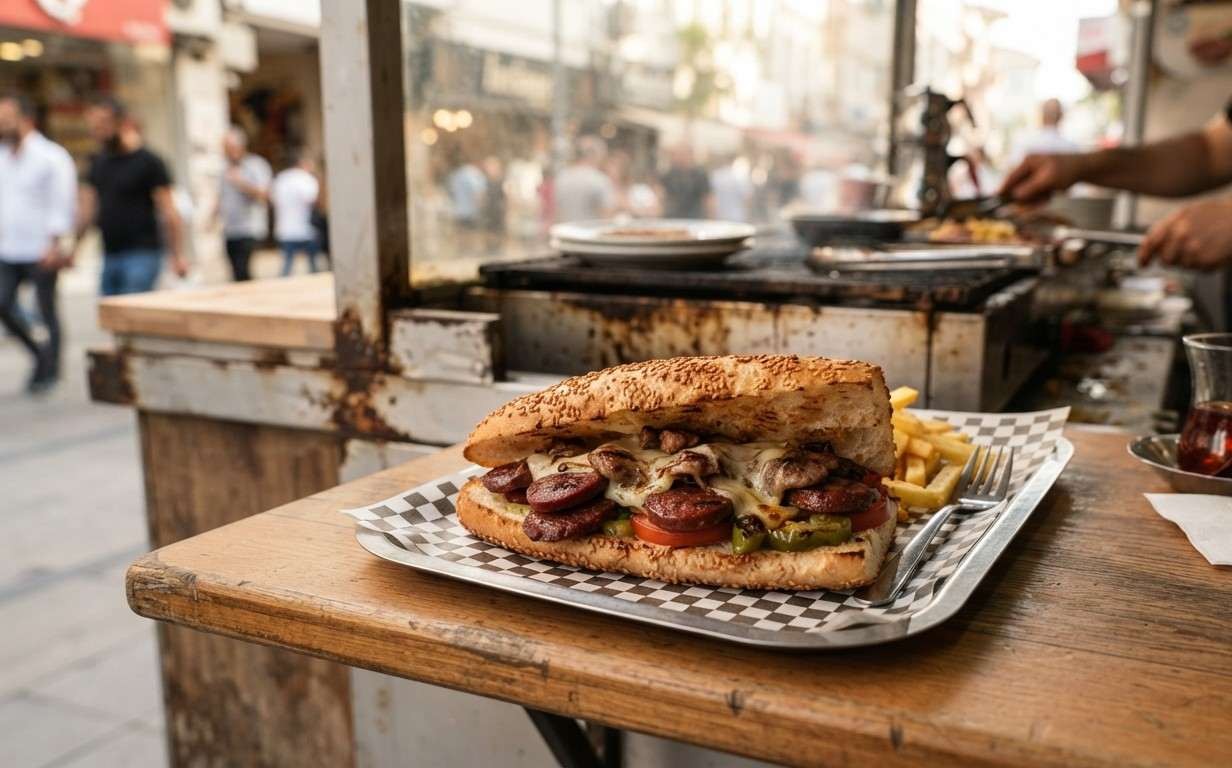
The classic İzmir-style kumru is built around a special oval-shaped bread covered generously with sesame seeds. The bread is toasted or grilled until its exterior becomes crisp while the inside remains pleasantly soft.
Inside, the sandwich is typically filled with a combination of grilled sucuk (Turkish fermented sausage), sosis (sausage), and salam (salami-style deli meat), along with kaşar cheese, tomatoes, and green peppers.
The ingredients are placed on the hot bread and grilled together, allowing the cheese to melt and the flavors of the meat to mingle.
The result is rich, salty, smoky, cheesy, slightly spicy, and wonderfully satisfying.
However, there is an important detail: not every kumru is the same.
The word “kumru” can refer to different regional preparations, and the sandwich commonly associated with İzmir is itself a particular interpretation of the dish.
That variety is part of what makes kumru interesting.
The Story Behind the Name
One of the most charming aspects of kumru is its name.
In Turkish, “kumru” means “dove.”
The name is generally associated with the shape of the traditional bread, which has been described as resembling a dove or bird-like form.
The bread is one of the defining elements of the sandwich. Unlike an ordinary sliced loaf or standard sandwich roll, kumru bread has its own character: compact, sesame-covered, slightly chewy, and designed to hold up beautifully against grilled fillings.
This means that the bread is not merely a container for the ingredients.
It is part of the experience.
A good kumru begins with good bread.
When it hits the grill, the sesame seeds become fragrant, the crust develops a light crunch, and the interior warms up enough to absorb the juices and melted cheese from the filling.
That combination of texture and aroma is one of the first things that makes kumru memorable.
İzmir and the Culture of Street Food
To understand kumru, it helps to understand İzmir.
Located on Turkey’s Aegean coast, İzmir has a food culture shaped by its geography, history, and cosmopolitan character.
The city has long been a meeting point of different cultures and communities. Its cuisine reflects influences from across the Aegean and Anatolia, while seafood, olive oil, vegetables, herbs, breads, cheeses, and grilled foods all play important roles in local eating habits.
Street food naturally fits this environment.
İzmir is a city where people spend significant time outdoors. Cafés, markets, seaside promenades, neighborhood streets, and busy commercial districts create countless opportunities for informal meals.
And street food works particularly well because it is fast without necessarily feeling anonymous.
A local food stall or small sandwich shop can become part of a neighborhood’s identity.
Kumru belongs to this world.
It is not usually presented as a formal culinary masterpiece.
There is no need for elaborate plating.
The sandwich is wrapped, handed over, and eaten while hot.
That simplicity is precisely the point.
The Traditional Kumru Bread
If you have never eaten kumru before, the bread may be the first thing that surprises you.
Traditional kumru bread is recognizable by its oval, compact shape and generous coating of sesame seeds.
The sesame is not simply decoration.
When the bread is heated on the grill, the seeds release their aroma, creating a nutty fragrance that immediately mixes with the smell of grilled meat and melted cheese.
The exterior becomes crisp and toasted, while the interior stays soft enough to bite through easily.
This balance is important.
A sandwich containing several grilled meats and melted cheese needs bread strong enough to hold everything together without becoming dry or overwhelmingly dense.
The kumru roll manages to do exactly that.
And because it is toasted directly on the grill, it becomes part of the flavor profile rather than merely providing structure.
What Goes Inside a Classic Kumru?
There is no single universal recipe for every kumru shop, but the classic İzmir-style version commonly features several key ingredients.
Sucuk
Sucuk is one of the most recognizable flavors in Turkish cuisine.
This fermented, heavily seasoned sausage is usually made with beef and flavored with spices such as garlic, cumin, paprika, and black pepper.
When grilled, sucuk releases aromatic oils that spread across the hot cooking surface.
Inside a kumru, it provides much of the sandwich’s distinctive savory and spicy character.
A few slices can transform the entire sandwich.
Sosis
Turkish-style sausage, or sosis, contributes another texture and flavor to the filling.
Compared with sucuk, it is generally milder and smoother.
Its presence creates contrast: sucuk brings intense seasoning, while sosis adds a softer, more familiar sausage flavor.
Together, they create a more complex filling than using a single meat would.
Salam
Salam adds another layer of cured-meat flavor.
The combination of sucuk, sosis, and salam is one of the characteristics that separates a traditional İzmir-style kumru from many ordinary grilled sandwiches.
Each meat brings its own texture and seasoning.
Once everything is heated together, however, their flavors begin to merge.
Kaşar Cheese
Then comes the cheese.
Kaşar is a semi-hard Turkish cheese with a mild, slightly salty flavor and excellent melting qualities.
When placed between the hot meats and toasted bread, it melts into the filling.
This is where kumru becomes especially indulgent.
The cheese binds the different ingredients together and provides a creamy contrast to the crisp bread and grilled meat.
A well-made kumru should have cheese that is thoroughly melted without turning the sandwich into a greasy mess.
Tomatoes
Fresh tomato adds acidity and freshness.
That matters because the grilled meats and cheese are rich and salty.
The tomato cuts through that richness and provides a juicy contrast to the toasted bread.
It is a small ingredient with an important job.
Green Peppers
Green peppers add another layer of freshness and mild vegetal flavor.
Depending on the preparation, they may be grilled alongside the other ingredients or added afterward.
The slightly smoky taste of grilled pepper works particularly well with sucuk and kaşar.
The Magic Happens on the Grill
One of the defining characteristics of kumru is that the sandwich is not simply assembled cold.
The ingredients are brought together around heat.
The bread is toasted.
The meats are grilled.
The cheese melts.
The peppers soften.
The aromas combine.
This cooking process creates something greater than the individual ingredients.
Imagine walking past a kumru shop.
First you notice the smell of toasted sesame.
Then comes the aroma of sizzling sucuk.
A few seconds later, you smell melted cheese and grilled peppers.
By the time the sandwich is assembled, the entire area around the grill can smell like a small celebration of Turkish street food.
That sensory experience is an important part of eating kumru.
Kumru is not simply assembled—it is brought together by heat, aroma, and the rhythm of the grill.
— The spirit of İzmir street food
Kumru Is More Than One Sandwich
One of the interesting things about kumru is that the word does not describe only one preparation across Turkey.
There is also a traditional Çeşme kumru, associated with the town of Çeşme in İzmir Province.
The Çeşme version is particularly important when discussing the history and identity of kumru.
Traditional Çeşme kumru bread has a distinctive structure and is often filled with ingredients such as tomato, green pepper, and cheese.
Modern versions and variations can differ considerably.
Meanwhile, the version that many people associate with İzmir’s urban street-food culture is the loaded grilled sandwich featuring sucuk, sosis, salam, kaşar, tomatoes, and peppers.
This distinction is worth remembering.
If you ask different people what “kumru” means, you may receive different answers depending on where they are from and what kind of kumru they grew up eating.
Food traditions rarely fit neatly into one recipe.
The Difference Between Kumru and an Ordinary Grilled Sandwich
At first glance, someone unfamiliar with Turkish cuisine might look at kumru and think:
“Isn’t this just a grilled sausage sandwich?”
Not really.
The ingredients themselves may seem familiar, but the combination is distinctly Turkish.
The sesame-covered bread, sucuk, kaşar cheese, Turkish sausage, salam, tomatoes, peppers, and grilling technique create a specific flavor profile.
There is also a cultural difference.
Kumru is not simply a recipe that happens to have originated in İzmir.
It has become part of the city’s food identity.
That gives it a different significance.
A grilled sandwich can be recreated almost anywhere.
But eating kumru in İzmir means experiencing it where its cultural context exists.
The Perfect Bite
A good kumru is an exercise in contrast.
The first thing you notice is the toasted sesame bread.
Then comes the crisp exterior.
The interior is warm and soft.
The melted kaşar adds creaminess.
Sucuk provides spice and intense savory flavor.
Sosis and salam add additional meatiness.
Tomato contributes acidity.
Green pepper introduces freshness and a gentle vegetal note.
Together, the sandwich moves between textures and flavors with every bite.
Crunchy.
Soft.
Chewy.
Juicy.
Creamy.
Smoky.
Spicy.
Salty.
Fresh.
That balance is why kumru can feel surprisingly satisfying despite its simple construction.
When Do People Eat Kumru?
The beauty of street food is that it does not always require a special occasion.
Kumru can work as breakfast, lunch, dinner, or a late-night meal.
It is particularly suited to informal eating.
You can grab one while exploring the city.
You can eat it after spending time near the Aegean coast.
You can share one with friends or order your own when hunger strikes.
Late-night street food is especially important to urban food cultures, and a hot grilled sandwich is almost perfectly designed for that role.
After hours of walking, socializing, shopping, or enjoying İzmir’s nightlife, a hot kumru can feel like exactly the right ending to the evening.
Kumru and the Aegean Lifestyle
There is something about kumru that fits the Aegean lifestyle.
İzmir is famous for its relaxed atmosphere, seaside setting, outdoor cafés, promenades, and slower relationship with everyday life compared with some of Turkey’s more intensely paced cities.
Kumru reflects that informality.
It is substantial without being ceremonial.
It is local without being complicated.
It is flavorful without requiring a dining room.
And most importantly, it is meant to be enjoyed.
Food like this often tells us more about a city than an expensive restaurant can.
A fine-dining menu may demonstrate culinary technique.
A street sandwich can demonstrate how people actually eat.
Kumru belongs to the second category.
Where to Look for Kumru in İzmir
If you are visiting İzmir and want to experience kumru, neighborhood sandwich shops and traditional eateries are usually a better starting point than trying to find a highly formal restaurant.
Look for places where locals are ordering.
A busy grill is often a good sign.
You may see stacks of sesame-covered bread, slices of sucuk and salam ready beside the grill, cheese waiting to melt, and peppers and tomatoes prepared for assembly.
The preparation itself is part of the attraction.
Watch how the bread is heated.
Listen to the sizzling meat.
Notice how quickly the sandwich comes together.
Then eat it while it is still hot.
That is when kumru makes the most sense.
How Kumru Fits Into Turkish Street Food
Turkey has one of the world’s richest street-food cultures.
From döner and dürüm to simit, kokoreç, gözleme, midye dolma, balık ekmek, and countless regional specialties, Turkish street food is built around foods that are practical, affordable, flavorful, and strongly connected to place.
Kumru belongs comfortably within that tradition.
But it also demonstrates how regional identity works in Turkish cuisine.
Döner can be found across the country, but local versions differ.
Pide exists in many regions, with different toppings and techniques.
Börek appears in countless forms.
And kumru, too, changes depending on where you encounter it.
This regional diversity is one of the great pleasures of exploring Turkish food.
Instead of searching for one definitive recipe, it is often better to ask:
Where did this version come from?
— A question at the heart of regional food culture
Why Tourists Remember Kumru
Travelers often remember foods that are tied to experiences.
A sandwich eaten in a hotel restaurant can be delicious.
But a sandwich bought from a busy street shop, eaten while walking through an unfamiliar neighborhood, can become part of the memory of the entire trip.
Kumru has exactly that quality.
You are not only tasting meat, cheese, bread, and vegetables.
You are tasting a particular city.
The sesame-covered bread becomes associated with İzmir.
The smell of sucuk recalls the street.
The grilled peppers bring back the seaside atmosphere.
The casual way the sandwich is served becomes part of the memory.
That is the difference between eating a dish and experiencing a food culture.
Making Kumru at Home
Although eating kumru in İzmir offers the most authentic cultural experience, the basic idea can also be recreated at home.
Start with a good sesame-covered roll.
Prepare slices of sucuk, Turkish-style sausage, and salam.
Have kaşar cheese ready.
Slice fresh tomato and green pepper.
Heat a grill or heavy skillet.
Toast the bread until lightly crisp.
Grill the meats and peppers.
Place the cheese onto the hot ingredients so that it begins to melt.
Then assemble everything inside the toasted bread.
The goal is not to create a perfectly neat sandwich.
Kumru is supposed to feel substantial and generous.
Let the ingredients come together.
Let the cheese melt.
And most importantly, serve it immediately.
What to Drink With Kumru
Kumru is rich enough that a refreshing drink can work particularly well alongside it.
A classic Turkish tea is always an option, although cold drinks are especially appealing with a hot, grilled sandwich.
Ayran—the traditional yogurt-based drink—is another natural companion to many Turkish savory foods.
Its cool, tangy character provides a refreshing contrast to salty grilled meats and melted cheese.
For a simple street-food meal, kumru with ayran is difficult to beat.
The Importance of Simplicity
Perhaps the most interesting lesson of kumru is that great street food does not require an enormous ingredient list.
The sandwich is built from familiar components.
- Bread
- Meat
- Cheese
- Tomato
- Pepper
But the quality of those ingredients and the way they are cooked make all the difference.
The bread needs the right texture.
The meat needs proper grilling.
The cheese needs to melt.
The vegetables need to provide freshness.
The proportions need to work.
And the sandwich needs to reach the customer hot.
Street food rewards precision disguised as simplicity.
Kumru is a perfect example.
Kumru as a Symbol of İzmir
Cities often have foods that become unofficial symbols.
New York has its pizza.
Naples has its pizza.
Istanbul has countless foods associated with its neighborhoods and traditions.
And İzmir has kumru.
Of course, İzmir’s cuisine is far more diverse than one sandwich.
The city and surrounding Aegean region are home to seafood, olive-oil dishes, herbs, vegetables, pastries, desserts, and many other specialties.
But kumru has a special position because it is accessible.
You do not need a special reservation.
You do not need to understand a complicated menu.
You simply order a sandwich.
That accessibility is precisely what gives it power as a food symbol.
The Future of Kumru
Like many traditional street foods, kumru continues to evolve.
Modern restaurants may experiment with different fillings.
Some versions may emphasize premium ingredients.
Others may introduce new cheeses, sauces, meats, or vegetarian alternatives.
There is nothing unusual about this.
Food traditions survive partly because they adapt.
But the essential character of kumru remains recognizable:
good bread, grilled ingredients, melted cheese, and the unmistakable spirit of İzmir street food.
The challenge for modern interpretations is to innovate without losing the qualities that made the original beloved.
When that balance works, traditional street food can become relevant to a new generation without losing its identity.
Why You Should Try Kumru in İzmir
If you are traveling through western Turkey, İzmir deserves attention not only for its coastline, history, architecture, and vibrant city life, but also for its food.
And kumru should be high on the list.
It is inexpensive compared with a formal restaurant meal.
It is easy to find.
It is filling.
It is deeply local.
And it tells a story.
The story begins with a humble sesame-covered roll.
It continues with sizzling sucuk, sausage, and salam.
Then comes melted kaşar, grilled peppers, and fresh tomato.
Everything meets on a hot grill.
A few minutes later, the sandwich is wrapped and handed to you.
That is it.
No ceremony.
No complicated presentation.
Just a hot sandwich that has become part of a city’s identity.
Final Bite: The Legend Between Two Pieces of Bread
Kumru proves that legendary food does not have to be complicated.
Sometimes, the most memorable dishes are the ones people eat without thinking twice.
They eat them on the way home.
They order them after work.
They grab one while meeting friends.
They introduce them to visitors.
And eventually, the food becomes part of the identity of the place itself.
That is what happened with kumru.
Born from the street-food culture of İzmir and closely associated with the wider Aegean region, kumru has grown into one of Turkey’s most recognizable regional sandwiches.
Its magic lies in the combination of textures and flavors: sesame-crusted bread, smoky grilled meat, melted kaşar, juicy tomato, and green pepper.
But its real appeal goes beyond taste.
Kumru tastes like İzmir because it belongs to İzmir.
And if you ever find yourself walking through the city’s streets, with the Aegean breeze in the air and the smell of something sizzling on a nearby grill, follow that aroma.
There is a good chance it will lead you to a sandwich worth remembering.