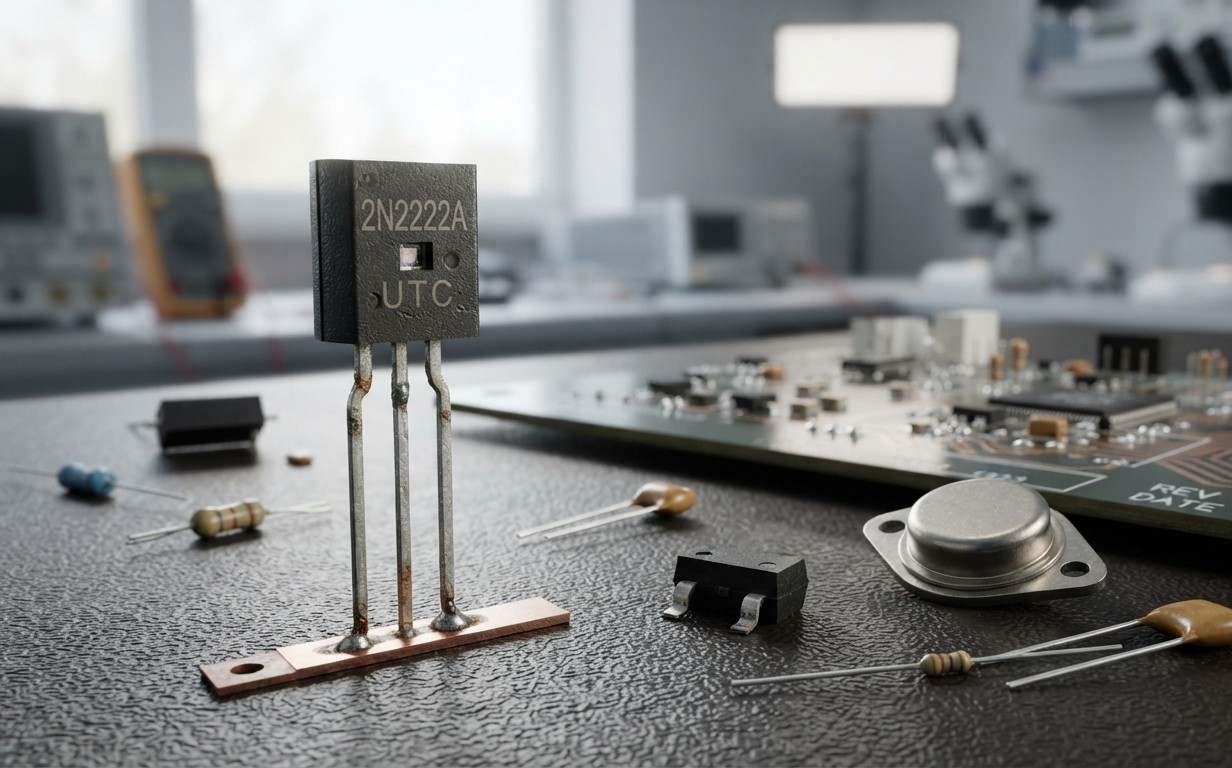
Modern technology can feel almost magical.
A smartphone can recognize your face in a fraction of a second. A laptop can process billions of calculations. A satellite can communicate across thousands of kilometers. A tiny smartwatch can monitor movement, display information, and connect to the internet.
Yet behind all of this incredible technology are extremely small electronic components.
Among the most important of them all is the transistor.
Often described as the building block of modern electronics, the transistor is one of the inventions that fundamentally changed the world. It made possible smaller computers, more efficient communication systems, digital electronics, microprocessors, smartphones, and virtually every modern computing device.
The transistor is tiny.
Its impact is enormous.
What Is a Transistor?
A transistor is a semiconductor device that can be used primarily to amplify electrical signals or act as an electronic switch.
That definition may sound simple, but these two capabilities are extraordinarily powerful.
A transistor can take a relatively small electrical signal and control a much larger current. It can also rapidly switch between different electrical states.
This switching ability is particularly important in digital electronics.
Computers fundamentally work with two logical states, commonly represented as:
- 0 — OFF
- 1 — ON
Millions, billions, and now even hundreds of billions of transistor-based switching elements can work together to perform calculations, store information, control devices, and execute software.
In other words, when you use a computer, you are ultimately interacting with a system built from enormous numbers of tiny electronic switches.
Why Are Transistors So Important?
Before transistors became widely available, electronic systems relied heavily on components called vacuum tubes.
Vacuum tubes could amplify and switch electrical signals, but they had serious disadvantages.
- Large
- Fragile
- Relatively inefficient
- Power-hungry
- Difficult to manufacture in enormous quantities
- Prone to generating significant heat
The transistor offered a radically different approach.
It was much smaller, required less power, generated less heat, and could be manufactured in large quantities.
This opened the door to a new era of electronics.
The development of transistor technology eventually transformed everything from radios and televisions to computers, telecommunications, medical equipment, automobiles, and industrial machinery.
A Brief History of the Transistor
The transistor was developed at Bell Telephone Laboratories in the United States during the 1940s.
Three scientists played particularly important roles in its development:
John Bardeen, Walter Brattain, and William Shockley.
In 1947, Bardeen and Brattain successfully demonstrated the first working point-contact transistor.
Shockley subsequently played a major role in developing the theoretical understanding and practical design of the transistor.
Their work was so significant that the three scientists received the 1956 Nobel Prize in Physics for research on semiconductors and the discovery of the transistor effect.
The invention represented a major turning point in technological history.
What began as an alternative to vacuum tubes would eventually become the foundation of the integrated circuits that power modern computing.
The transistor began as a tiny electronic invention and became the foundation of the digital age.
— A turning point in modern technology
How Does a Transistor Work?
To understand a transistor, it helps to start with the idea of a semiconductor.
A semiconductor is a material whose electrical conductivity falls between that of a good conductor and an insulator.
The most important semiconductor material in modern electronics is silicon.
By carefully modifying semiconductor materials through a process known as doping, engineers can create regions with different electrical properties.
These regions allow transistors to control the movement of charge.
Although transistor operation can become mathematically and physically complex, the basic concept can be understood through a simple analogy.
Imagine a water pipe.
A valve controls how much water can pass through the pipe.
The valve itself does not necessarily need to carry the full force of the water to control the flow.
A transistor works somewhat similarly.
A relatively small electrical input can control the flow of a larger electrical current.
This is why transistors are useful as both amplifiers and switches.
The Two Major Jobs of a Transistor
Although transistors can be used in many sophisticated ways, two fundamental applications stand out.
1. Switching
A transistor can behave like an extremely fast electronic switch.
It can allow current to flow or prevent it from flowing depending on the control signal.
This is the foundation of digital electronics.
Modern processors contain enormous numbers of transistors that switch between electrical states to perform logical operations.
Every calculation performed by a computer ultimately depends on these switching operations.
2. Amplification
Transistors can also be used to amplify electrical signals.
For example, a weak signal from a microphone can be used to control a stronger electrical signal that drives a speaker.
This makes transistors essential in:
- Audio amplifiers
- Radio transmitters
- Wireless communication
- Signal processing
- Sensors
- Instrumentation
- Telecommunications
Without amplification, many electronic communication systems would not be practical.
The Three Terminals of a Transistor
Many transistor types have three terminals through which electrical behavior is controlled.
For a Bipolar Junction Transistor (BJT), these are:
- Emitter
- Base
- Collector
For a Field-Effect Transistor (FET), the terminals are commonly:
- Source
- Gate
- Drain
Although the terminology differs, the fundamental idea is similar.
One terminal or region provides the control mechanism, while the other terminals are involved in the main current path.
Understanding these terminals is one of the first steps toward understanding electronic circuits.
Bipolar Junction Transistors
One of the earliest major transistor families is the Bipolar Junction Transistor, commonly called a BJT.
BJTs are available primarily in two forms:
NPN
An NPN transistor uses semiconductor regions arranged as:
N – P – N
PNP
A PNP transistor uses:
P – N – P
The two types behave differently with respect to voltage polarity and current direction, but both can be used for switching and amplification.
BJTs played an enormous role in the early development of electronic technology and remain useful in many applications today.
Field-Effect Transistors
Another major transistor family is the Field-Effect Transistor, or FET.
Instead of controlling current primarily through a base current as in a BJT, a FET uses an electric field associated with its control terminal to influence current flow.
One of the most important types is the MOSFET.
MOSFET stands for:
Metal-Oxide-Semiconductor Field-Effect Transistor.
MOSFETs became extremely important because they can be manufactured at enormous scale and can operate with very low power.
They are fundamental components of modern integrated circuits.
MOSFETs and Modern Computing
If you use a smartphone, computer, gaming console, tablet, or modern vehicle, you are relying heavily on MOSFET technology.
Microprocessors, memory chips, graphics processors, communication chips, and countless other integrated circuits are constructed from transistor structures based largely on MOS technology.
The power of this approach comes from miniaturization.
Engineers can manufacture extremely small transistor structures and place enormous numbers of them onto a single piece of semiconductor material.
This is what allows a tiny chip to perform tasks that once required entire rooms filled with electronic equipment.
From Individual Transistors to Integrated Circuits
Early electronic systems used individual transistors as separate components.
Engineers would connect these components together using wires and circuit boards.
But eventually, researchers developed a way to manufacture multiple electronic components on a single semiconductor substrate.
This led to the development of the integrated circuit, commonly called an IC or chip.
Instead of building a complex circuit from thousands of individually packaged components, manufacturers could place many components directly onto one piece of semiconductor material.
Transistors became the fundamental active elements inside these circuits.
The result was a dramatic reduction in size and cost while increasing reliability and performance.
The Rise of the Microprocessor
One of the most important consequences of transistor miniaturization was the development of the microprocessor.
A microprocessor integrates the core processing functions of a computer onto a single chip.
Instead of requiring large collections of separate electronic components, computers could increasingly perform their processing inside compact semiconductor devices.
As transistor counts increased, processors became more capable.
They could execute more instructions.
They could process more data.
They could support increasingly sophisticated software.
And eventually, computers became small enough to fit on desks, inside phones, and even into everyday household objects.
Moore’s Law and Transistor Scaling
The rapid growth of computing power is closely associated with Moore’s Law, an observation made by Intel co-founder Gordon Moore.
Moore observed that the number of components that could be placed on an integrated circuit had historically increased at a remarkable rate.
Although Moore’s Law was never a fundamental law of physics, it became a useful description of the semiconductor industry’s long-term trend.
As manufacturing technology improved, engineers were able to create smaller transistor structures and place more of them onto chips.
More transistors generally meant more opportunities for computation, memory, functionality, and performance.
For decades, this scaling drove extraordinary advances in computing.
Why Smaller Transistors Matter
Making transistors smaller has several important advantages.
Smaller transistors can allow more devices to fit onto the same chip area.
They can also reduce the distances electrical signals need to travel within a circuit.
This can contribute to greater performance and efficiency.
But transistor scaling is not unlimited.
As transistor structures become extremely small, engineers face increasingly difficult challenges involving:
- Heat
- Power consumption
- Leakage currents
- Manufacturing complexity
- Quantum effects
- Material limitations
- Production costs
The semiconductor industry has therefore developed increasingly sophisticated transistor structures and manufacturing techniques to continue improving performance.
From Planar Transistors to 3D Structures
Early integrated-circuit transistors were generally based on relatively flat, planar structures.
As transistor dimensions became smaller, however, simply shrinking the same design became increasingly difficult.
This led to new structures.
One important development was the FinFET.
Instead of having the transistor channel essentially confined to a flat surface, FinFET designs use a three-dimensional fin-like structure.
The gate can surround more of the channel, providing improved control over the transistor.
More recently, semiconductor manufacturers have been moving toward even more advanced structures such as gate-all-around transistors.
These developments demonstrate how transistor engineering continues to evolve as conventional scaling becomes more challenging.
Transistors Inside a Smartphone
Your smartphone may look like a screen, camera, battery, and collection of apps.
Internally, however, it is an extraordinarily sophisticated electronic system containing numerous semiconductor chips.
Those chips contain enormous numbers of transistors.
They help control:
- CPU operations
- Graphics processing
- Memory
- Wireless communication
- Camera processing
- Audio
- Power management
- Artificial intelligence workloads
- Sensors
Every time you open an application, take a photograph, connect to Wi-Fi, or play a video, transistor-based circuits are performing countless operations behind the scenes.
The device in your hand is effectively a highly advanced transistor system.
Transistors in Computers
Computers depend on transistors at almost every level of their hardware.
The central processing unit uses transistors to implement logic and perform calculations.
Memory chips use transistor-based structures to store information.
Graphics processors use huge numbers of transistors to perform parallel computations.
Storage controllers, network interfaces, and other components also depend on semiconductor circuits.
A modern computer therefore is not simply a machine containing a processor.
It is an ecosystem of semiconductor devices built from transistor technology.
Transistors in Everyday Life
You do not have to own a computer to encounter transistors.
They are everywhere.
- Televisions
- Cars
- Washing machines
- Refrigerators
- Cameras
- Medical equipment
- Industrial robots
- Smartwatches
- Routers
- Game consoles
- Audio systems
- Solar power systems
- Communication satellites
Modern vehicles can contain numerous electronic control systems, many of which depend on semiconductor components.
Even devices that appear primarily mechanical increasingly contain sophisticated electronic systems.
Transistors and Digital Logic
Computers do not understand human concepts directly.
At the hardware level, digital systems manipulate electrical states.
Transistors can be arranged into logic gates, such as:
- AND
- OR
- NOT
- NAND
- NOR
- XOR
These gates can then be combined into more complex circuits.
For example, groups of logic gates can create:
- Adders
- Multipliers
- Registers
- Counters
- Memory elements
- Control units
- Processing circuits
Ultimately, enormously complex processors can be constructed from combinations of relatively simple transistor-based building blocks.
This is one of the most remarkable ideas in electronics.
A sophisticated computer program may appear abstract and complicated, yet underneath it all are physical devices switching electrical signals.
Transistors and Memory
Transistors are not limited to computation.
They are also essential to electronic memory.
Different memory technologies use transistor-based structures in different ways.
For example, dynamic random-access memory, or DRAM, uses transistor-and-capacitor structures to store bits.
Flash memory uses specialized transistor structures that can retain information even when power is removed.
This technology powers:
- USB drives
- Solid-state drives
- Memory cards
- Smartphones
- Embedded storage
Without transistor technology, modern high-capacity electronic storage would look dramatically different.
Transistors in Amplifiers and Audio
The transistor’s ability to amplify signals made it revolutionary for audio and communications.
An audio signal generated by a microphone may initially be very weak.
An amplifier can increase that signal to a level capable of driving a speaker.
Transistor-based amplifiers made electronic audio systems smaller, more reliable, and more practical.
They became widely used in:
- Radios
- Televisions
- Hi-fi systems
- Musical equipment
- Public-address systems
- Recording equipment
- Headphones
Even modern wireless earbuds contain tiny transistor-based amplifiers and signal-processing circuits.
Transistors and Communication
Modern communication systems rely heavily on transistors.
Radio-frequency circuits use specialized transistors to generate, amplify, switch, and process signals.
This technology enables communication through:
- Mobile networks
- Wi-Fi
- Bluetooth
- Satellite systems
- Radio
- Television broadcasting
- Radar
Every wireless connection involves complex electronic circuitry operating at high speeds.
Transistors make much of this possible.
The Role of Silicon
When people think about transistors, they often think of silicon.
There is a good reason.
Silicon has several properties that make it extremely useful for semiconductor manufacturing.
It is abundant, its electrical characteristics can be controlled through doping, and it forms a useful oxide layer that has historically been central to MOS transistor technology.
The semiconductor industry developed enormous manufacturing infrastructure around silicon.
That infrastructure allows manufacturers to produce incredibly sophisticated chips at high volume.
However, silicon is not the only semiconductor material used in electronics.
Other materials have important applications where their properties provide advantages.
Beyond Silicon
As electronics evolve, researchers and engineers continue to explore alternative semiconductor materials.
- Gallium nitride
- Silicon carbide
- Gallium arsenide
- Indium phosphide
These materials can offer advantages for particular applications.
For example, gallium nitride and silicon carbide are particularly important in power electronics because they can perform well under demanding voltage, temperature, and frequency conditions.
They are increasingly relevant to areas such as:
- Electric vehicles
- Renewable energy
- Fast chargers
- Power supplies
- Industrial systems
The future of transistor technology therefore extends beyond conventional silicon alone.
Transistors and Artificial Intelligence
The growth of artificial intelligence has created another enormous demand for transistor technology.
AI systems often require vast amounts of computation.
Modern AI accelerators and graphics processors can contain billions of transistor structures working together to perform mathematical operations.
These processors are designed to execute large numbers of operations efficiently and in parallel.
When an AI model processes an image, generates text, recognizes speech, or analyzes data, sophisticated semiconductor hardware is carrying out the underlying calculations.
At the physical level, those calculations ultimately depend on transistors switching and controlling electrical signals.
The Challenge of Heat
One of the biggest challenges in modern electronics is heat.
Every transistor consumes some amount of energy during operation, and large numbers of transistors switching at high speeds can produce significant heat.
This creates an important engineering challenge.
More computational power can require more energy.
More energy can produce more heat.
More heat can limit performance.
Engineers therefore work continuously to improve transistor efficiency, circuit design, semiconductor materials, packaging, and cooling technologies.
This is one reason energy efficiency has become just as important as raw performance.
How Many Transistors Are in a Modern Chip?
The answer depends heavily on the type of chip.
Simple integrated circuits may contain relatively small numbers of transistors.
Modern high-performance processors and graphics chips can contain billions of transistors.
Some advanced chips contain tens of billions or more.
The incredible part is not merely the number.
It is the precision with which these devices are manufactured.
Each transistor must perform its intended function while being integrated with millions or billions of neighboring structures.
This requires extraordinarily advanced manufacturing technology.
How Are Transistors Manufactured?
The manufacturing process is highly sophisticated.
It begins with a semiconductor wafer, typically made from extremely pure silicon.
Manufacturers then build structures onto the wafer through a series of processes involving:
- Deposition
- Photolithography
- Etching
- Doping
- Cleaning
- Metallization
- Inspection
These processes are repeated many times.
Photolithography is particularly important because it allows microscopic circuit patterns to be transferred onto the semiconductor surface.
The final result is a wafer containing many individual chips.
The wafer is then cut into individual pieces, packaged, and tested.
A modern semiconductor factory is therefore less like a traditional workshop and more like an extremely precise combination of laboratory, manufacturing facility, and automated production environment.
Why Transistors Are Called Building Blocks
The phrase “building block” is appropriate because transistors can be combined in countless ways.
A single transistor can perform a simple switching or amplification function.
A few transistors can form a logic gate.
Multiple logic gates can form a functional circuit.
Thousands or millions of such circuits can create larger systems.
Billions of transistor structures can create sophisticated processors.
This hierarchy is fundamental to electronics:
Transistor → Logic Gate → Circuit → Integrated Circuit → Processor/System
The complexity emerges from combining simple elements in carefully designed ways.
The Transistor’s Impact on Society
The transistor did not merely improve electronic devices.
It changed society.
The ability to build smaller, cheaper, more reliable electronics accelerated the development of modern communication and computing.
Transistor technology contributed to the growth of:
- Personal computing
- Mobile phones
- The internet
- Digital entertainment
- Modern medicine
- Satellite communication
- Automation
- Industrial control
- Artificial intelligence
Entire industries were transformed.
Products that once required specialized facilities became consumer technologies.
Computing power that once belonged to governments and large institutions eventually became available to individuals.
The transistor helped make that transformation possible.
From Room-Sized Computers to Pocket-Sized Devices
One of the best ways to appreciate the importance of transistors is to compare early computers with modern devices.
Early electronic computers could occupy enormous rooms.
They required significant electrical power and extensive maintenance.
Modern smartphones, meanwhile, can fit into a pocket while providing vastly greater computational capability.
This transformation was not caused by one invention alone.
It required decades of progress in semiconductor manufacturing, circuit design, software, materials science, and engineering.
But at the heart of that progress was the ability to manufacture increasingly capable transistor-based circuits.
The Future of Transistors
The story of the transistor is far from over.
Engineers continue to explore new architectures, materials, manufacturing techniques, and ways of integrating transistors into increasingly sophisticated systems.
Future developments may focus on:
- Greater energy efficiency
- Advanced three-dimensional transistor structures
- Specialized AI processors
- New semiconductor materials
- Advanced packaging
- Chiplet-based systems
- Quantum and hybrid computing technologies
- High-performance power electronics
The goal is not simply to make transistors smaller.
It is to make electronic systems faster, more efficient, more reliable, and more capable.
Why Transistors Still Matter
Technology changes incredibly quickly.
The phones, computers, and processors we use today would have seemed impossible to engineers several decades ago.
Yet the fundamental transistor concept remains central.
Its importance comes from its versatility.
- A transistor can amplify.
- A transistor can switch.
- Transistors can be combined.
- They can be manufactured at enormous scale.
- They can form the foundation of increasingly complex electronic systems.
That combination of properties is what made the transistor one of the most important inventions in technological history.
Final Thoughts
The next time you use a smartphone, start a computer, connect to Wi-Fi, play a video game, or turn on a modern electronic device, remember that beneath the visible interface is an extraordinary world of microscopic engineering.
At the center of that world are transistors.
They are too small to see with the naked eye, yet billions of them can work together inside a chip smaller than a coin.
They switch.
They amplify.
They process signals.
They store information.
They control power.
And collectively, they enable the digital world around us.
From the first experimental transistor demonstrated in the 1940s to today’s highly advanced semiconductor processors, the technology has undergone an extraordinary transformation.
The transistor began as a solution to the limitations of vacuum tubes.
It became the foundation of integrated circuits.
Integrated circuits became microprocessors and memory chips.
Those chips became the engines behind computers, smartphones, communication networks, vehicles, medical equipment, and artificial intelligence.
That is why the transistor deserves its reputation as one of the true building blocks of modern electronics.
It may be microscopic in size, but its influence on human civilization is anything but small.